
 NL
NL
 EN
EN
 DE
DE
Most microscopes are standardly equipped with 4/0.10, 10/0.25, 40/0.65, and 100/1.25 objectives. A 20/0.40 or 25/0.45 objective was and is only supplied upon special request. This is unfortunate while a 20/0.40 or 25/0.45 is one of the most useful and pleasant-to-use objectives. Anyone considering purchasing a new microscope would be much better off choosing a 20/0.40 objective than a 100/1.25 objective. Achromatic lenses with 20x or 25x magnification are all-rounders and offer many advantages. These objectives fill the gap between 10x and 40x. A 40x objective is often too high a magnification for many objects, let alone a 100x. A 20/0.40 objective provides a good overview while simultaneously allowing many details to be seen. For studying pond life, a 20/0.40 is one of the most useful objectives. A 20/0.40 achromatic objective has a fairly large working distance, which is convenient for thicker slides. Furthermore, good oblique and darkfield illumination can be very easily achieved with this objective. The darkfield image of a 20/0.40 is impressive, partly due to the very black background.
Unbranded 20/0.40 objectives can be ordered from a microscope supplier or online at various sites. However, there is something strange going on with 20/0.40 objectives from importer brands: the numerical aperture (NA), the number 0.40, is often incorrect. The NA determines the resolving power of the objective and is therefore the most important property of an objective. Companies that import Chinese microscopes rarely perform quality control. It is one of the reasons why those microscopes and lenses are and were much cheaper than those from renowned brands such as Zeiss, Leitz, and Olympus. Why the NA of particularly 20/0.40 lenses often turns out to be inaccurate is not entirely clear to me. Perhaps the problem arises because 20/0.40 lenses are not standard and too few of them are manufactured.
In practice, the NA of unbranded 20/0.40 lenses regularly turns out to be smaller compared to the same lenses from a renowned brand. However, sometimes the NA is even slightly larger than that of a renowned lens. The latter is, of course, not a problem. But when the NA is smaller, it immediately comes at the expense of image quality. I compared the NA of 5 different unbranded 20/0.40 lenses, using an Olympus 20/0.40 lens as a reference. The image quality of the lenses ranged from good to downright poor.
The following lenses were tested:
- Achromat 20/0.40, short barrel objective. This type of objective is often found in educational microscopes in the lower price segment. Parfocal length: 35 mm.
- Achromat 20/0.40 45 EP. I have not encountered this objective before. Parfocal length: 45 mm.
- Achromat 20/0.40, chrome version. A common type of objective often seen in educational microscopes. Parfocal length: 45 mm.
- Achromat 20/0.40, black version. Also quite common among various importer brands. Parfocal length: 45 mm.
- Planachromat 20/0.40, metallic grey version and, in terms of appearance, a copy of Olympus EA objectives. Parfocal length: 45 mm.
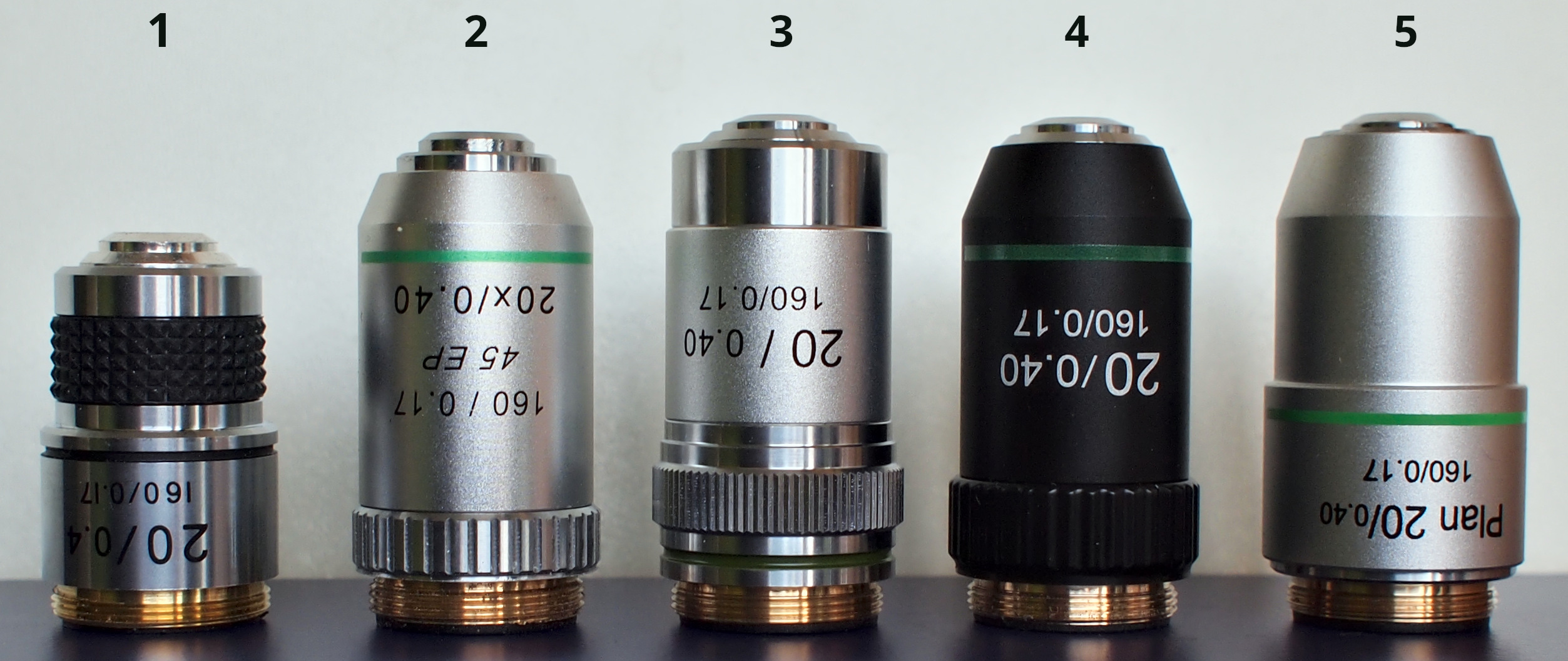
Five different unbranded 20/0.40 objectives, numbered 1-5.

Illumination at the back of objectives 1-5 photographed with a phase telescope. The condenser diaphragm was set the same for all objectives. The size of the illuminated circle indicates the degree to which the aperture is illuminated. In other words: the larger this circle, the smaller the objective aperture. The first objective clearly has the smallest aperture.
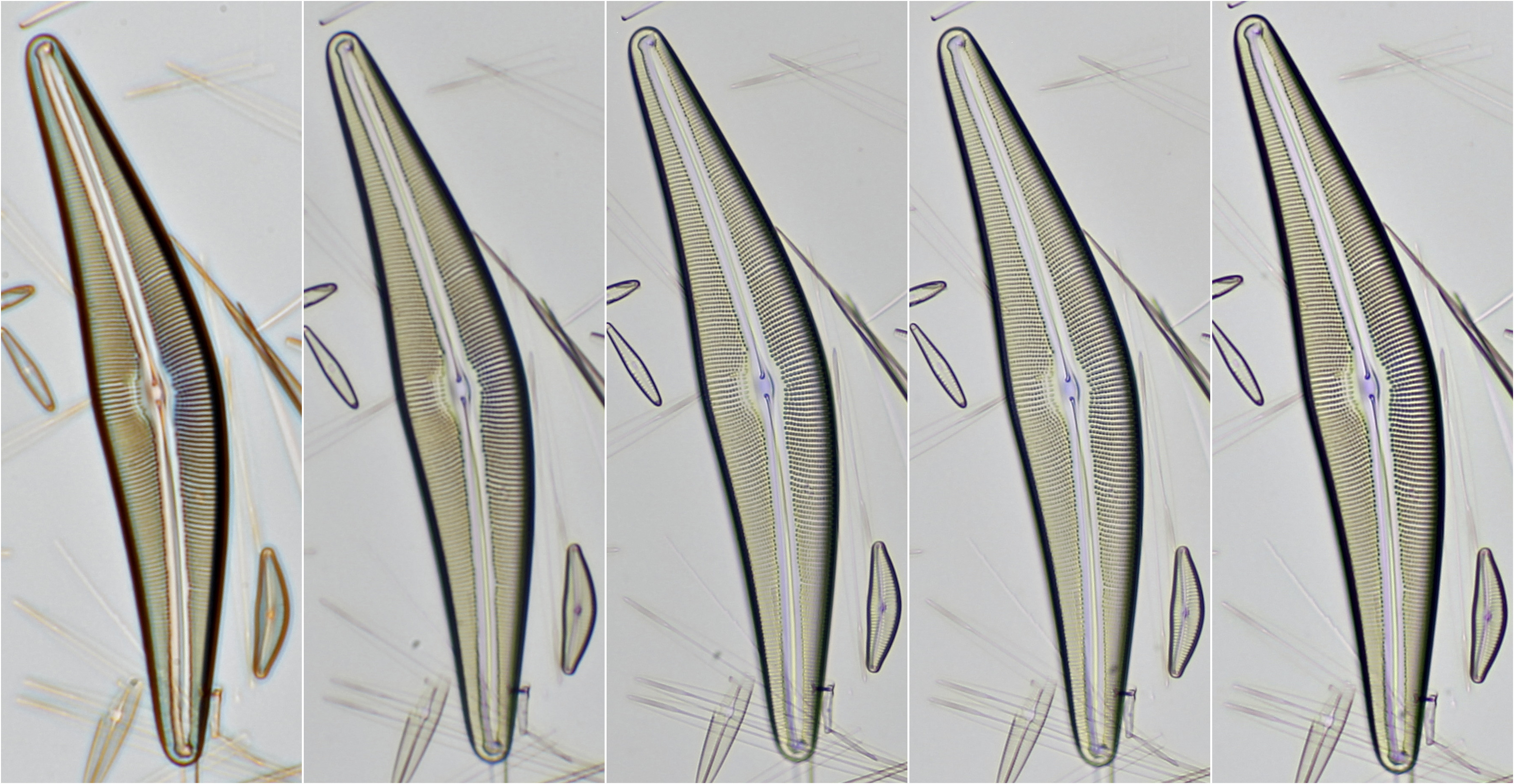
Cymbella photographed with objectives 1-5. It is clear that objectives 1 and 2 have the lowest resolving power; the details of the diatom are not well resolved.
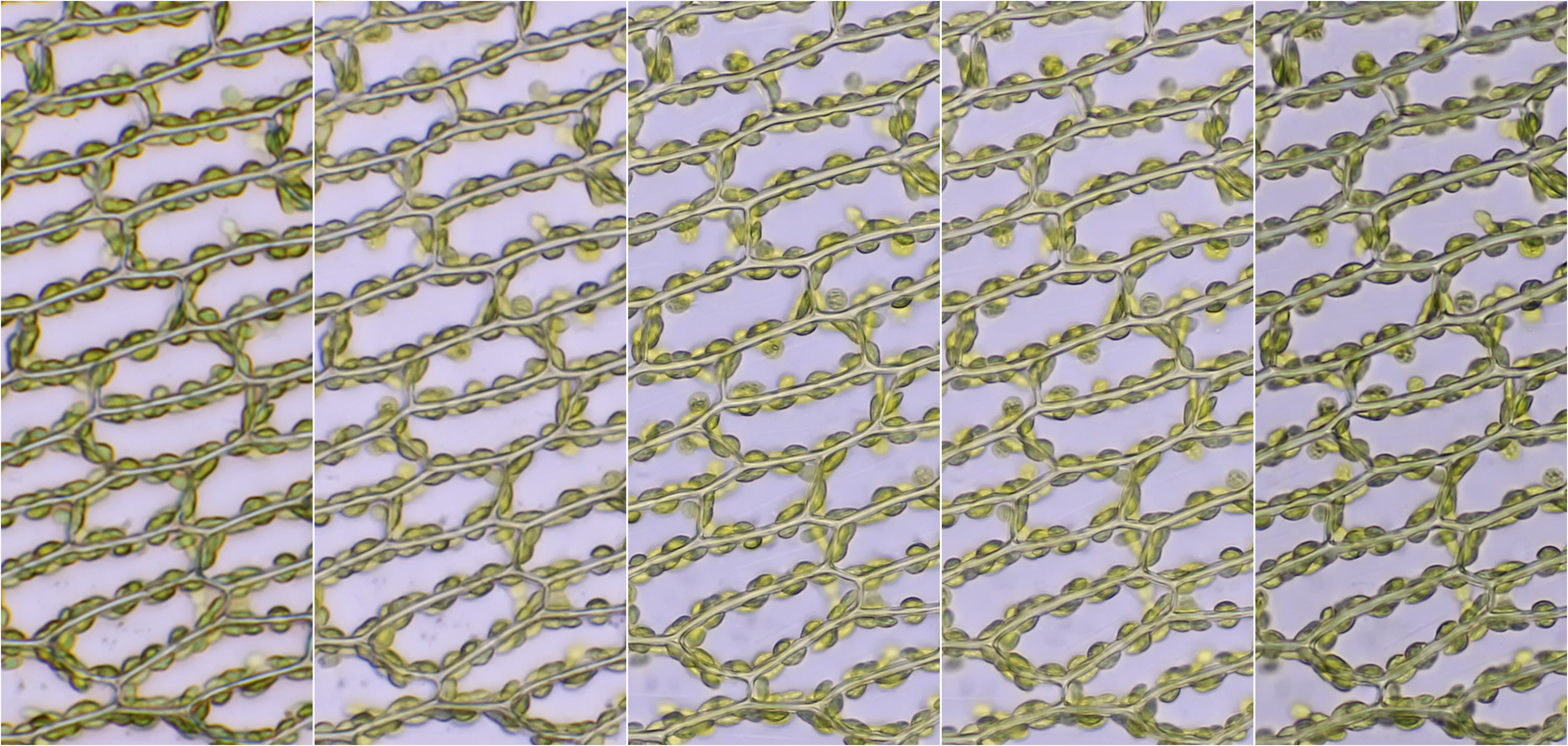
A moss leaf photographed with lenses 1-5. Here too, it is clearly visible that the details are rendered least well with the first two objectives (numbers 1 and 2).
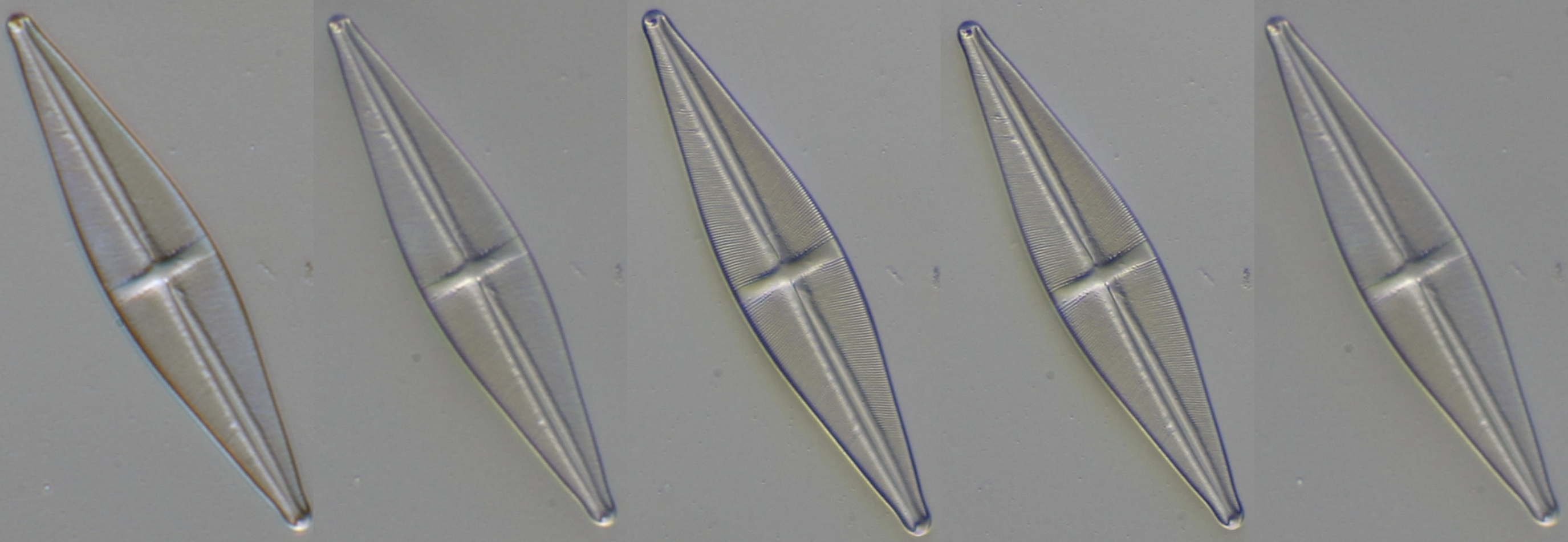
Stauroneis, photographed with oblique lighting with lenses 1-5. Only with objectives 3 and 4 are some finer details visible.
The first two objectives (numbers 1 and 2) can simply be described as poor, with objective no. 1 scoring just slightly worse than objective no. 2. The NA of objective no. 1 turns out to be barely greater than that of a 10/0.25 lens. Actually, this is a 10/0.25 objective with a magnification of 20x. I have held two such objectives in my hands and both had this problem. Objective no. 1 can be found on the cheaper Bresser and Euromex microscopes, among others. These typically feature the standard objectives 4, 10, and 40. Ordering an additional objective 20 of this type seems like a guarantee of disappointment.
Conclusion
With unbranded 20/0.40 objectives, the aperture frequently deviates from the value stated on the lens. When purchasing no-name 20x achromats, it is therefore recommended to inquire with the supplier.