
 NL
NL
 EN
EN
 DE
DE
Introduction
Nowadays, there are various adapters available to connect a system camera to a microscope. These adapters can be inserted into the tube in place of an eyepiece. Broadly speaking, they can be divided into two types: adapters without optics and adapters with an internal optical element. Adapters without optics are virtually unusable. Due to the absence of optics, disturbing hotspots and light reflections can occur; you then see a light spot or circle in the center of the image. Moreover, the parfocality between the objectives is lost.
The disadvantage of adapters with optics is that they do not correct residual errors in the image of objectives calculated for a finite mechanical tube length (usually 160 or 170 mm). The result is strong chromatic aberration that manifests as colored fringes around objects that are not in the center of the field of view.
However, adapters that can be inserted into a tube have a major advantage: it is the simplest and most flexible method to connect a camera to a microscope. The adapter can be inserted into any tube with an inner diameter of 23.2 mm and quickly removed again. With a monocular microscope, photography can thus be easily alternated with visual observation. These adapters are also easy to use with a binocular microscope. For example, if one has a binocular Zeiss Standard GFL, a clamp adapter (intended for 25 mm tubes) cannot simply be attached to it. It does not fit due to the adjustment rings present that correct the tube length. However, DSLR adapters with internal optics are not cheap, which is a disadvantage.
At one point, I wondered what would happen if I added an extra lens to the system. The results were surprising.
The experiments
I started experimenting with an NDPL-1 adapter that features an optical element with 2x magnification. I investigated what the effect would be if I inserted an extra lens into this adapter. First, I checked if eyepiece lenses would be usable. This turned out not to be the case. Next, I started experimenting with various field lenses (the bottom lens of an eyepiece). Some field lenses proved to correct the residual errors of 160 mm and 170 mm objectives nicely. Most field lenses fit exactly into the space available in the adapter; there is no play, as if it were made for it...
In addition to the correction of chromatic aberration by the field lens, a significantly larger portion of the field of view is also photographed than when no field lens is present. The field lens is placed in the adapter with the convex (bulging) side facing upwards.
At the moment, I am still in the process of testing various field lenses, so this page will be updated regularly. The photos were taken with a Canon EOS 600D (APS-C sensor) and an Olympus PEN E-PL1 (micro 4/3 sensor) camera. For photography with the Canon, only a T2 ring is required. With the Olympus PEN, an additional extension ring was needed to create the correct distance between the field lens and the camera sensor.
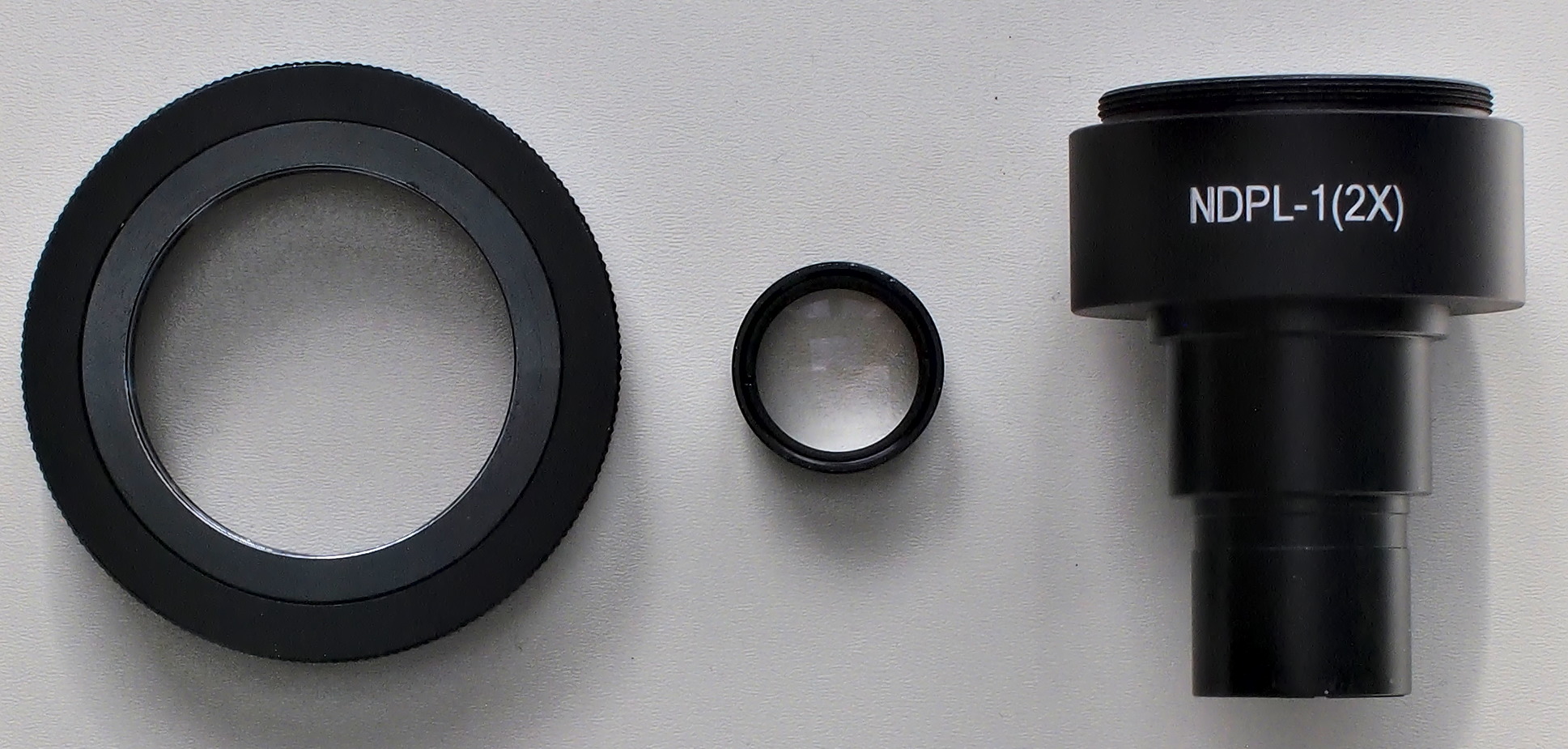
The parts required to use a Canon 600D in combination with a universal DSLR adapter. From left to right: T2 ring for Canon, field lens from eyepiece, DSLR adapter NDPL-1.
Carl Zeiss
The field lens of a Leitz Periplan NF10x eyepiece proved to correct the residual errors of Carl Zeiss objectives nicely when using the Canon 600D camera. To use this fieldlens with the Olympus PEN E-PL1, an extension ring was required to get the best results. I used a Caruba extension ring set for this and extended the distance between the adapter and the camera bayonet mount by 26 mm.
The field lens of a Carl Zeiss Kpl8x eyepiece also functioned well with the Olympus PEN camera when a 16 mm extension ring was used.
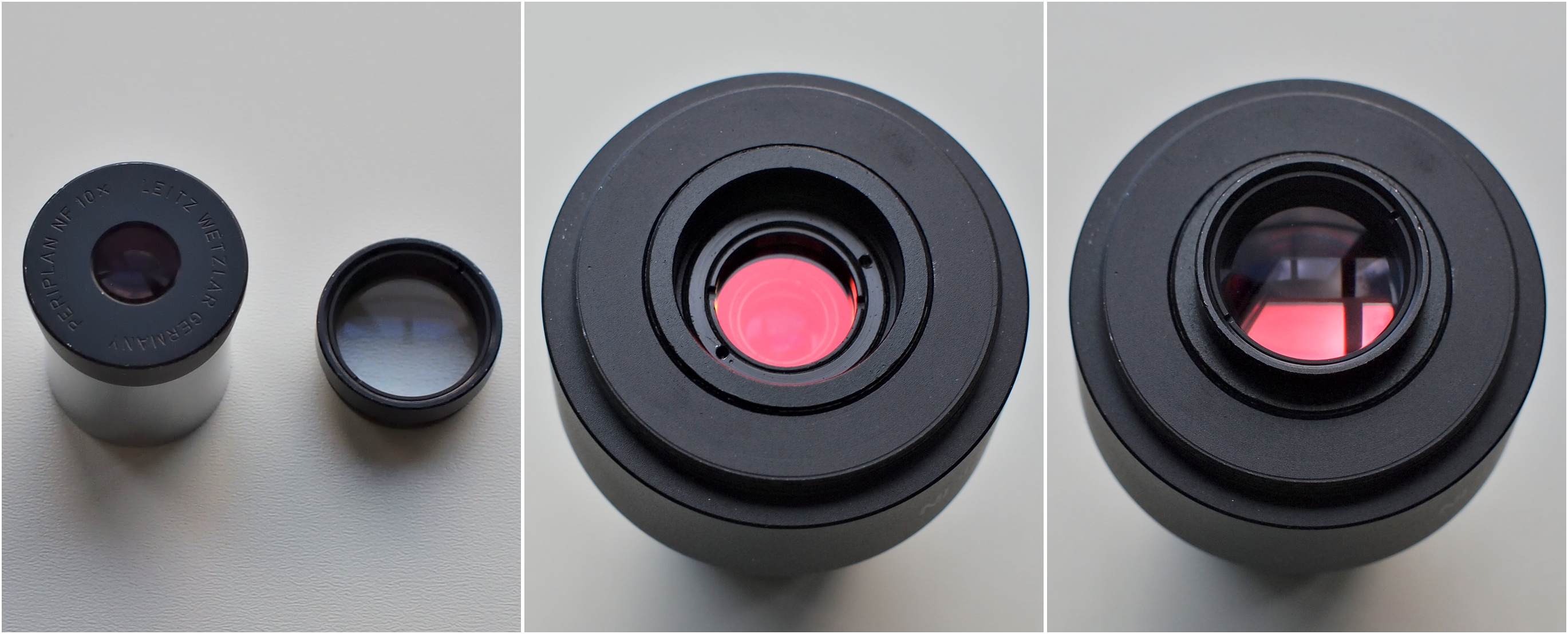
The field lens of a Leitz Periplan NF10x eyepiece (left) is inserted into the adapter. The space for this is perfect; it fits exactly.
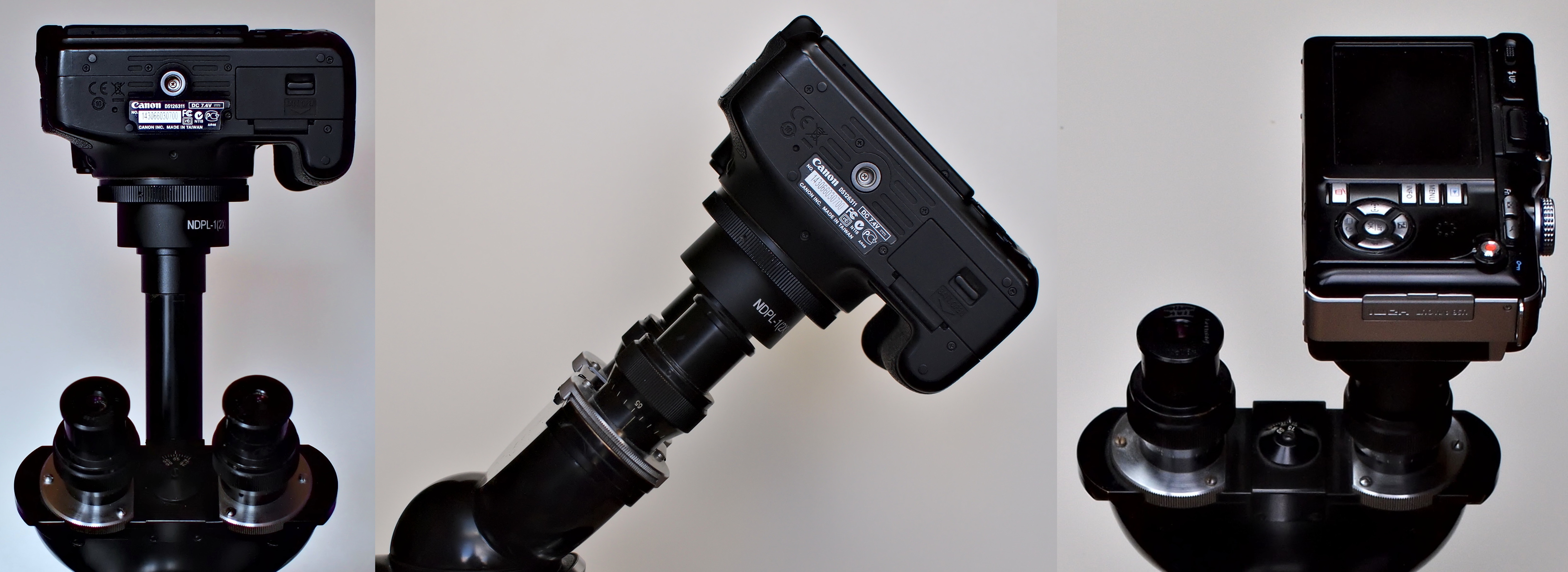
Left and center: Canon 600D camera installed on a Zeiss Standard GFL with trinocular tube and binocular tube. Right: Olympus PEN E-PL1 on the binocular tube of the Zeiss Standard GFL.
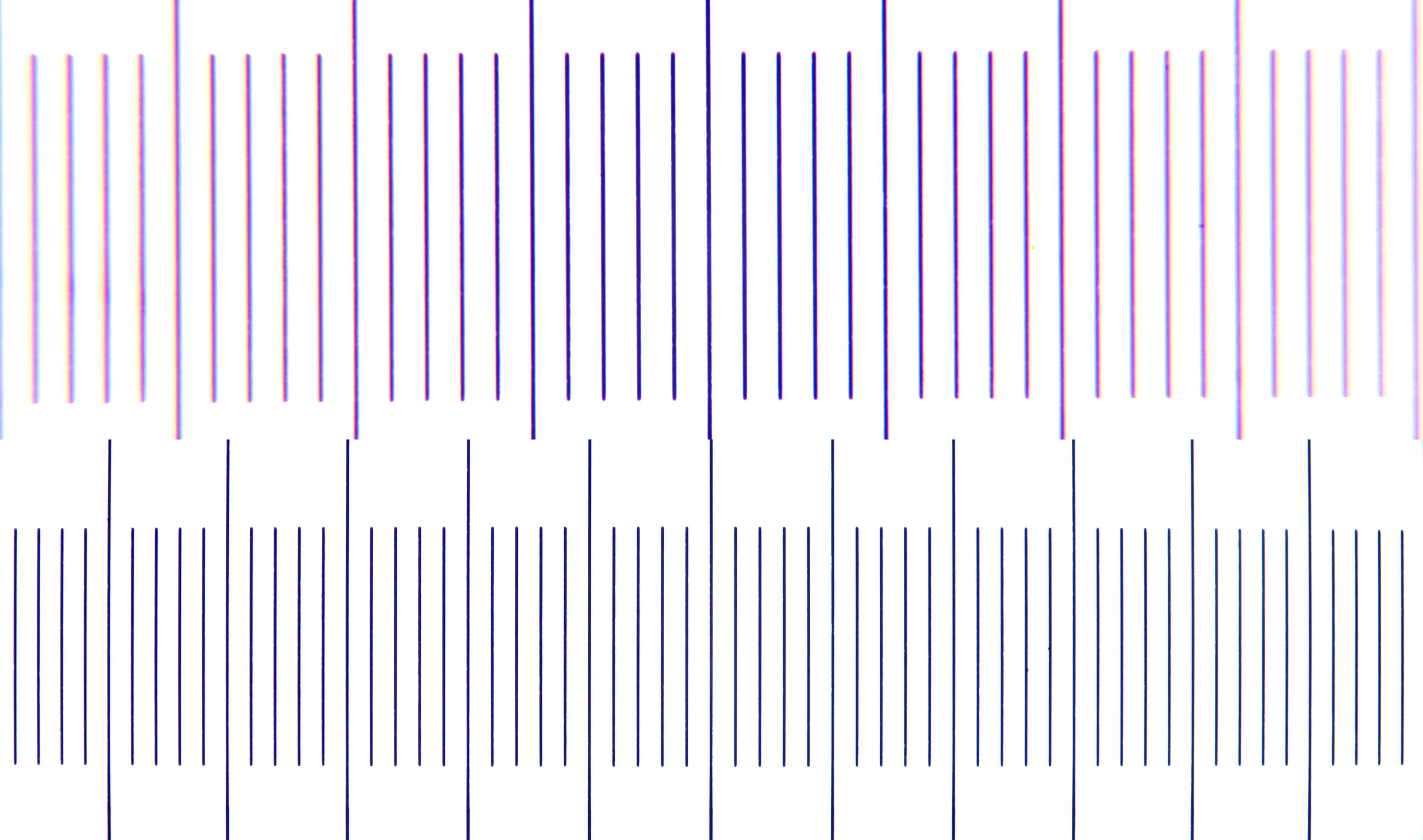
Stage micrometer photographed with a Carl Zeiss Plan 25/0.45 and universal DSLR adapter. Top: without field lens. Bottom: with the field lens of a Leitz Periplan NF10x eyepiece. The top photo clearly shows chromatic aberration towards the edges. The portion of the field of view being photographed is significantly larger with the field lens. Slight barrel distortion occurs which will not be visible in normal slides. Camera: Canon 600D.
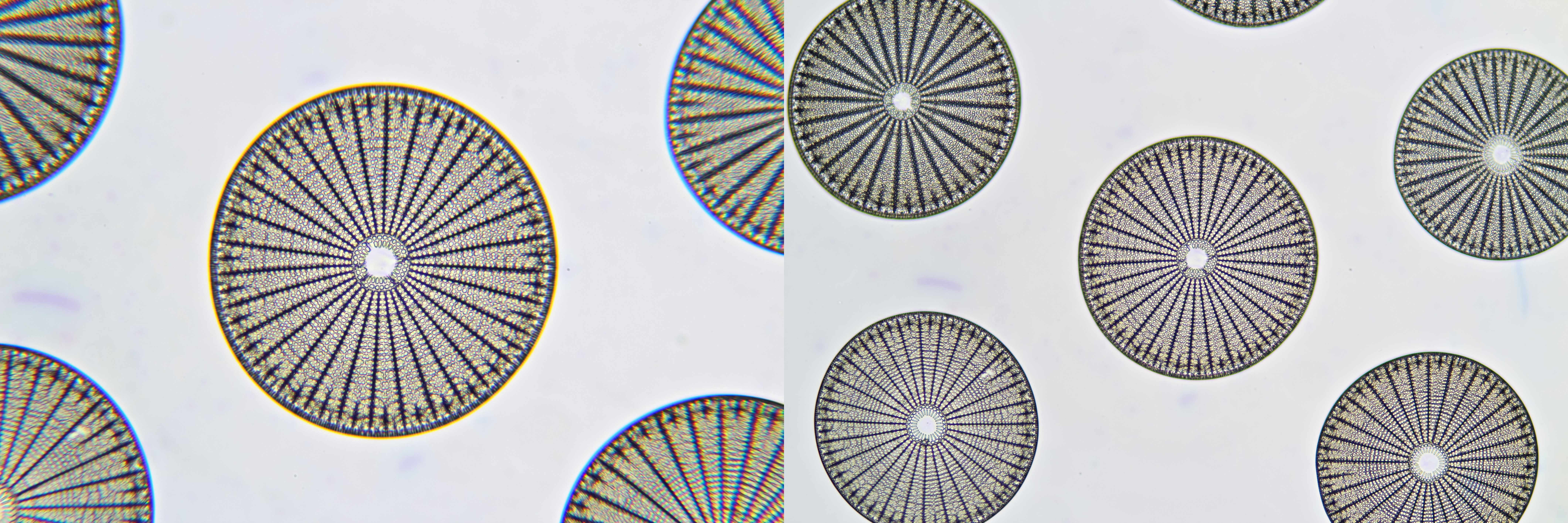
A slide with Arachnoidiscus photographed with a Carl Zeiss Plan 25/0.45. Left: DSLR adapter without field lens. Right: DSLR adapter with Periplan NF10x field lens. Note the strong chromatic aberration in the left image. Camera: Canon 600D.
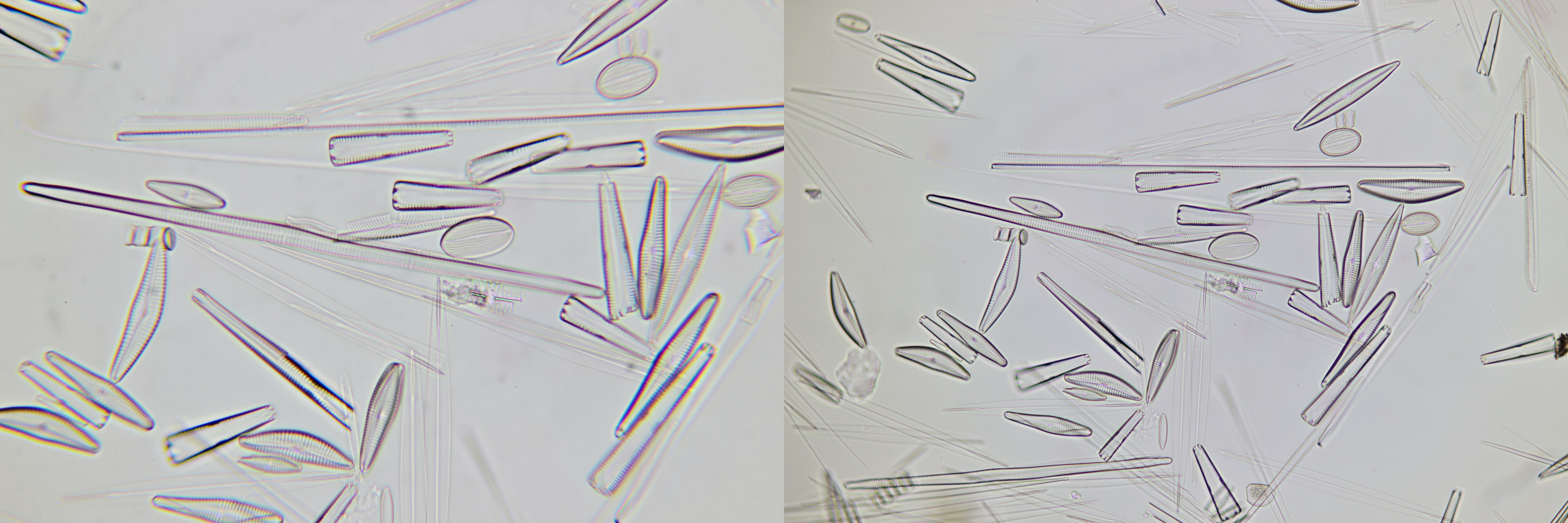
Diatoms photographed with Carl Zeiss Neofluar 40/0.75. Left: DSLR adapter without field lens. Right: DSLR adapter with Periplan NF10x field lens. Camera: Canon 600D.
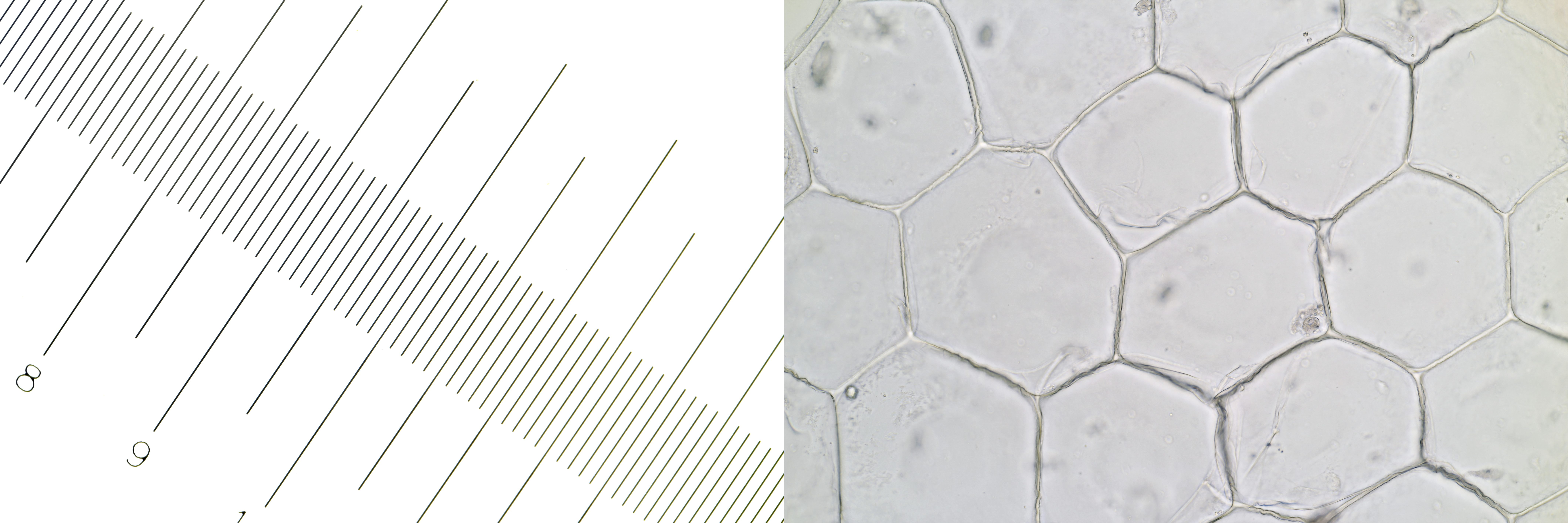
Satge micrometer (left) and the epidermis of Tradescantia zebrina (right) photographed with a Zeiss Planapo 25/0.65. The Leitz Periplan NF10x field lens was used here. Camera: Canon 600D.
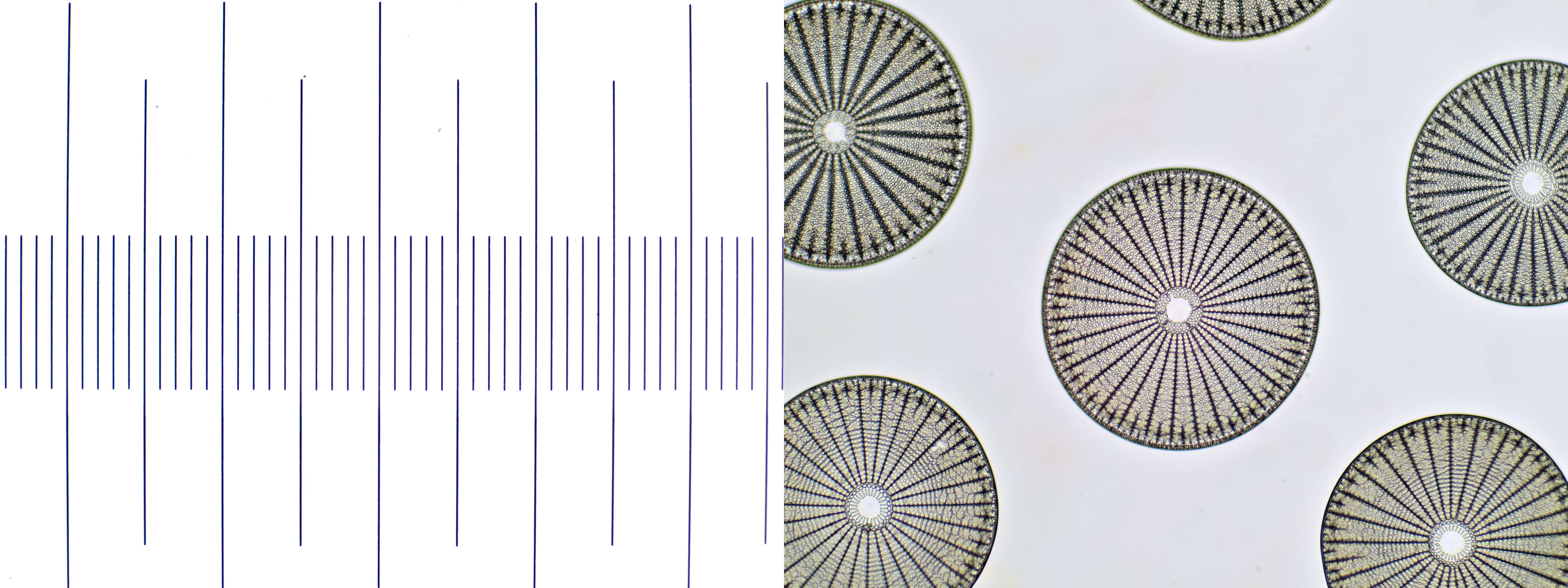
Stage micrometer (left) and Arachoidiscus (right) photographed with a Carl Zeiss Plan 25/0.45 objective and Olympus PEN E-Pl1 camera. The field lens of a Carl Zeiss Kpl8x eyepiece was used here. The distance between the adapter and the bayonet of the Olympus camera was increased by 16 mm using an extension ring.
Leitz
For Leitz 160 and 170 mm objectives as well, a field lens from Leitz Periplan eyepieces proved to provide the necessary correction. For this purpose, I used the field lens from a Leitz Periplan GF10x/18, Leitz Periplan 6.3x/18 (both for 160 mm), and Leitz Periplan GF10x (for 170 mm). With the Periplan 6.3x field lens, there was slightly more chromatic aberration with the NPL Fluotar objectives, but not with the Leitz EF objectives. A larger portion of the field of view is photographed when using the Canon camera with the Periplan 6.3x/18 field lens. I conducted the experiments with these lenses using, among others, the Leitz Laborlux-12 (160 mm) and Leitz Dialux-II (170 mm). The mentioned field lenses can be used on both systems. Here too, only the T2 ring is needed for photography with the Canon 600D camera. For photography with the Olympus PEN E-PL1, I used a 16 mm extension ring to create the correct distance between the field lens and the camera sensor.
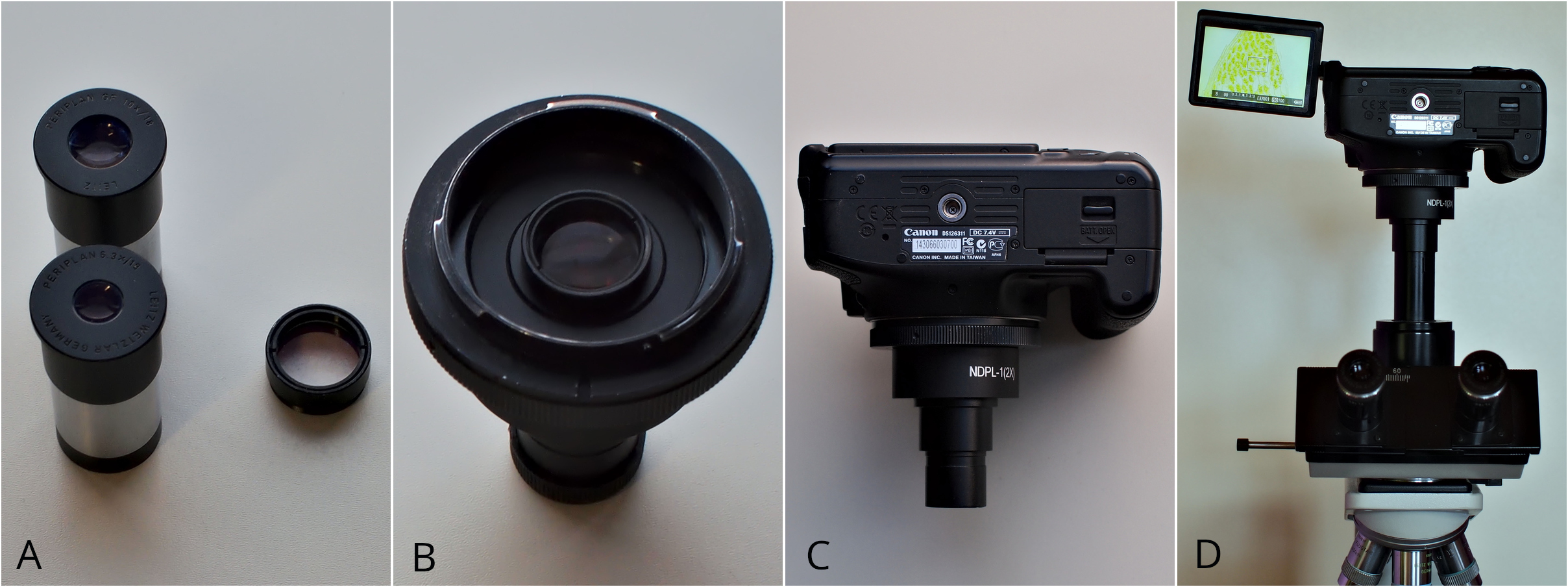
Modification of the DSLR adapter for Leitz optics. A: Leitz Periplan GF10x/18 and Leitz Periplan 6.3x/18 with one of the a field lenses displayed. The field lens of both eyepieces can be used. B: DSLR adapter with field lens and T2 ring for Canon. C: Canon 600D camera with mounted DSLR adapter. D: Mounting of the Canon camera on a Leitz Laborlux-12 microscope.

Stage micrometer photographed with Leitz NPL Fluotar 25/0.55. Above: DSLR adapter without field lens. Below: DSLR adapter with the field lens of a Leitz Periplan GF10x/18 eyepiece. Camera: Canon 600D.

Satge micrometer photographed with Leitz EF 40/0.65. Top: DSLR adapter without field lens, field width approx. 230 μm. Bottom: DSLR adapter with the field lens of a Leitz Periplan 6.3x/18 eyepiece, field width approx. 345 μm. Camera: Canon 600D.
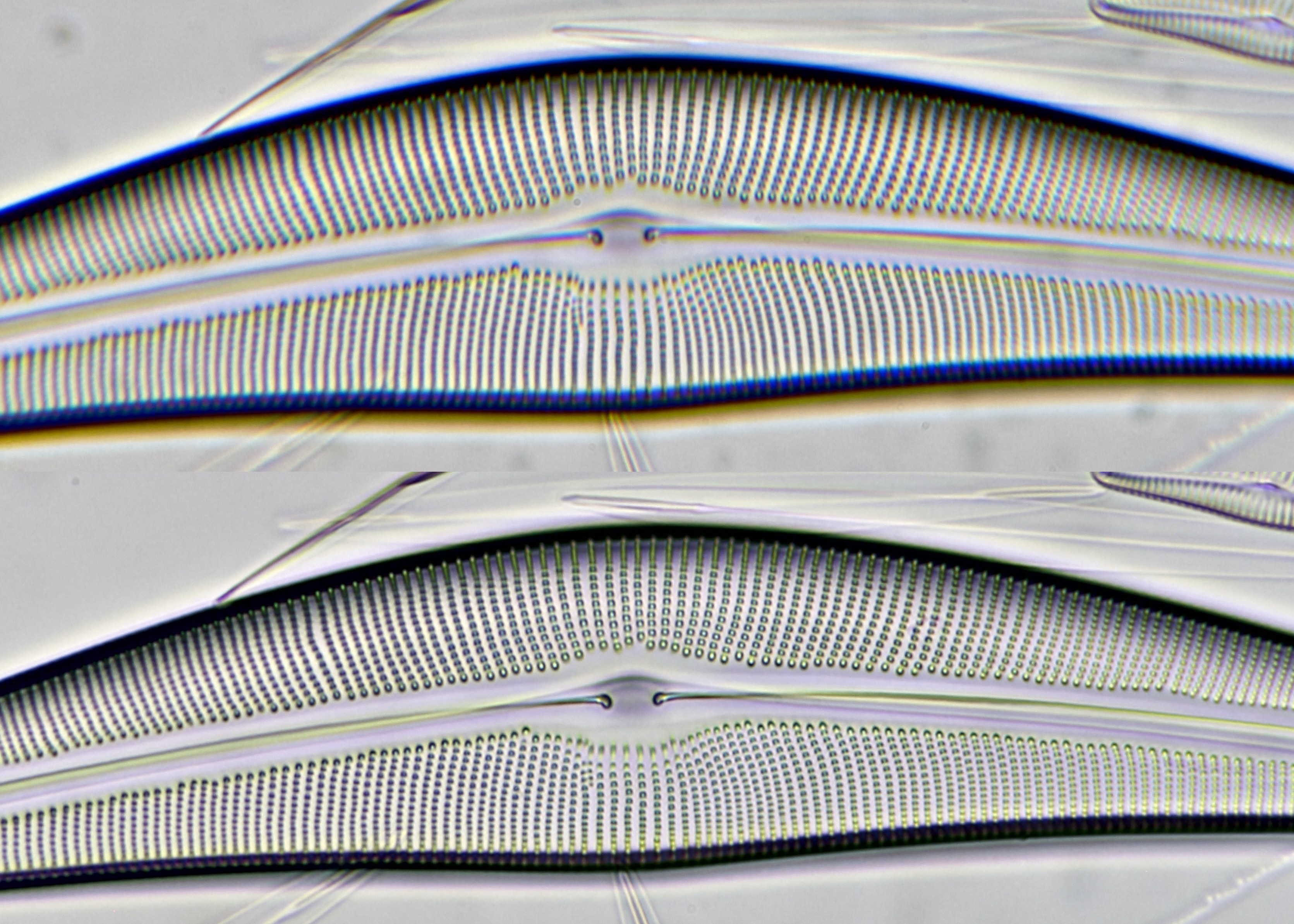
A Cymbella specimen located off-center in the field of view, photographed with a Leitz NPL Fluotar 40/0.70. Above: DSLR adapter without field lens. Below: DSLR adapter with the field lens of a Leitz Periplan GF10x-18 eyepiece. The strong chromatic aberration is clearly visible in the upper picture. Camera: Canon 600D.
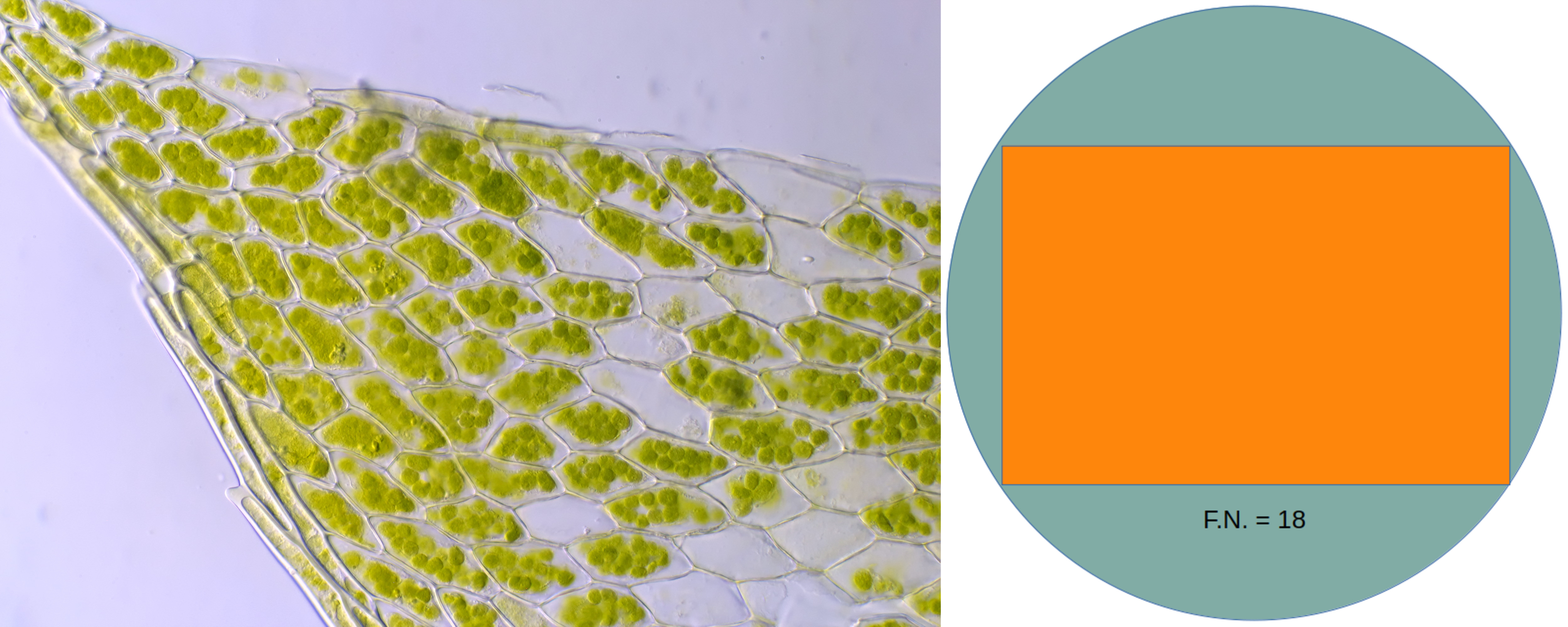
A moss photographed with a Leitz NPL Fluotar 40/0.70 and the DSLR adapter (left). Here, the field lens of a Leitz Periplan 6.3x/18 was used. Right: field of view of a Leitz Periplan GF10x eyepiece with field number 18, with the portion being photographed with a Canon 600D camera indicated in orange.
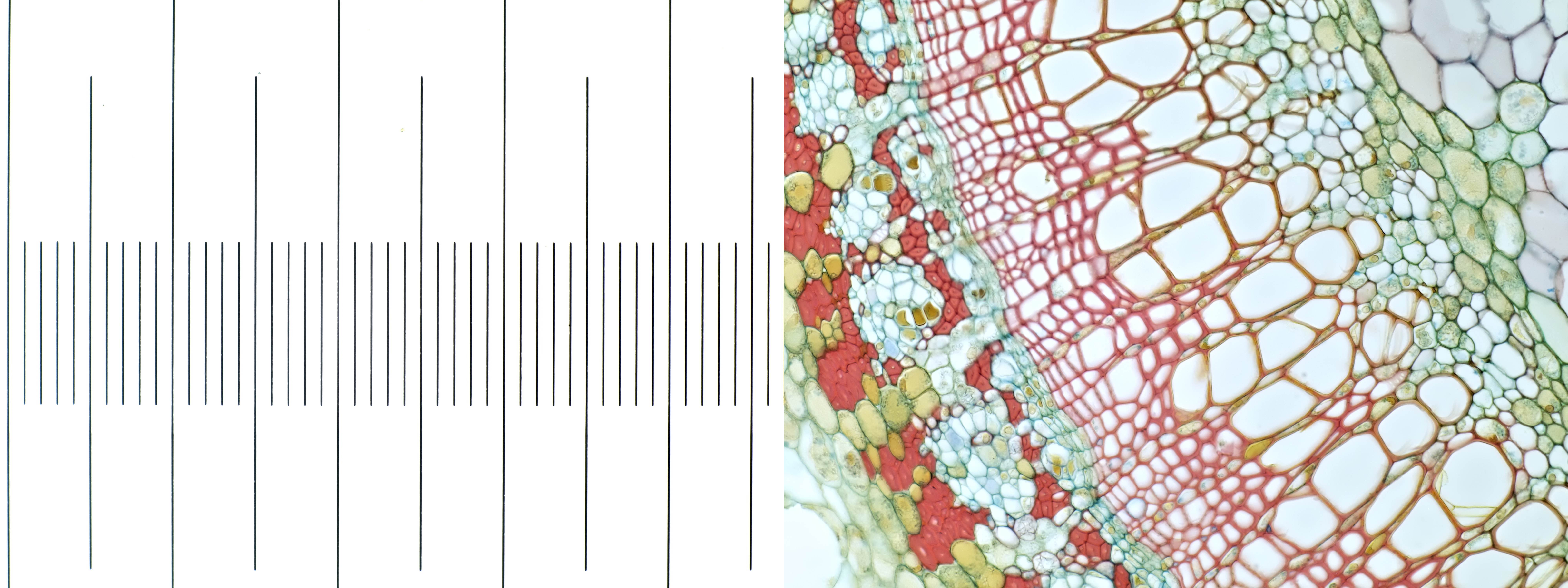
Stage micrometer and a slide from a stem of Tilia, photographed with a Leitz NPL Fluotar 25/0.55 and Olympus PEN E-PL1 camera. The field lens of a Leitz Periplan 6.3x/18 was used here.
Olympus
Regarding the short-barrel (37 mm) Olympus objectives, the field lens of simple Huygens 5x eyepieces proved to work well with the higher-magnification objectives. Objectives ≤ 10/0.25 require hardly any compensation: the adapter can then be used without a field lens. Both field lenses from unbranded 5x eyepieces and 5x eyepieces from various brands gave reasonably good results. It was striking that all the 10x Huygens eyepieces I tested gave poor results. The eyepiece magnification seems to be important here. For the next test, I used the field lens of a Beck Kassel CBS 5x eyepiece to correct the image from an Olympus 40/0.65.
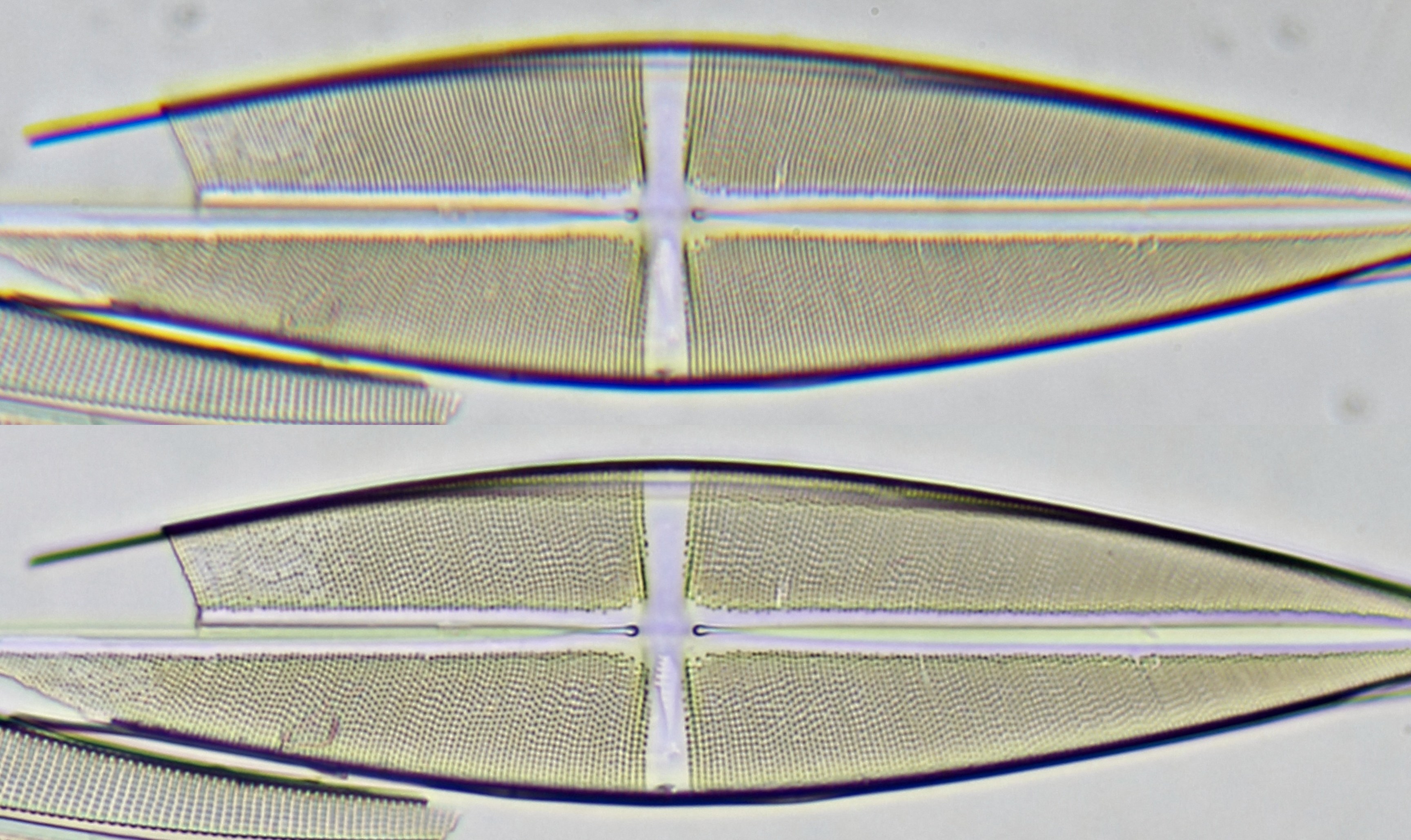
A Stauroneis specimen located off-center in the field of view, photographed with an Olympus 40/0.65. Above: DSLR adapter without field lens. Below: DSLR adapter with the field lens of a Beck Kassel CBS 5x eyepiece. Clear correction of chromatic aberration in the bottom image. Camera: Canon 600D.
Objectives with a parfocal length of 45 mm were well corrected when the field lens of a Leitz Periplan GF10x was used in combination with the Canon 600D camera. The experiments were done with a Olympus BH2 microscope. The BH2's phototube was normally connected to a system camera via a special adapter (OM Photomicro Adapter L), using NFK projectives. This system is no longer very practical with current digital cameras. Moreover, the photographic setup with the adapter in question was built up quite high. With the NDPL-1 adapter, a camera can now be connected much more simply, and the setup is considerably shorter.
The photos below were taken with the BH2.
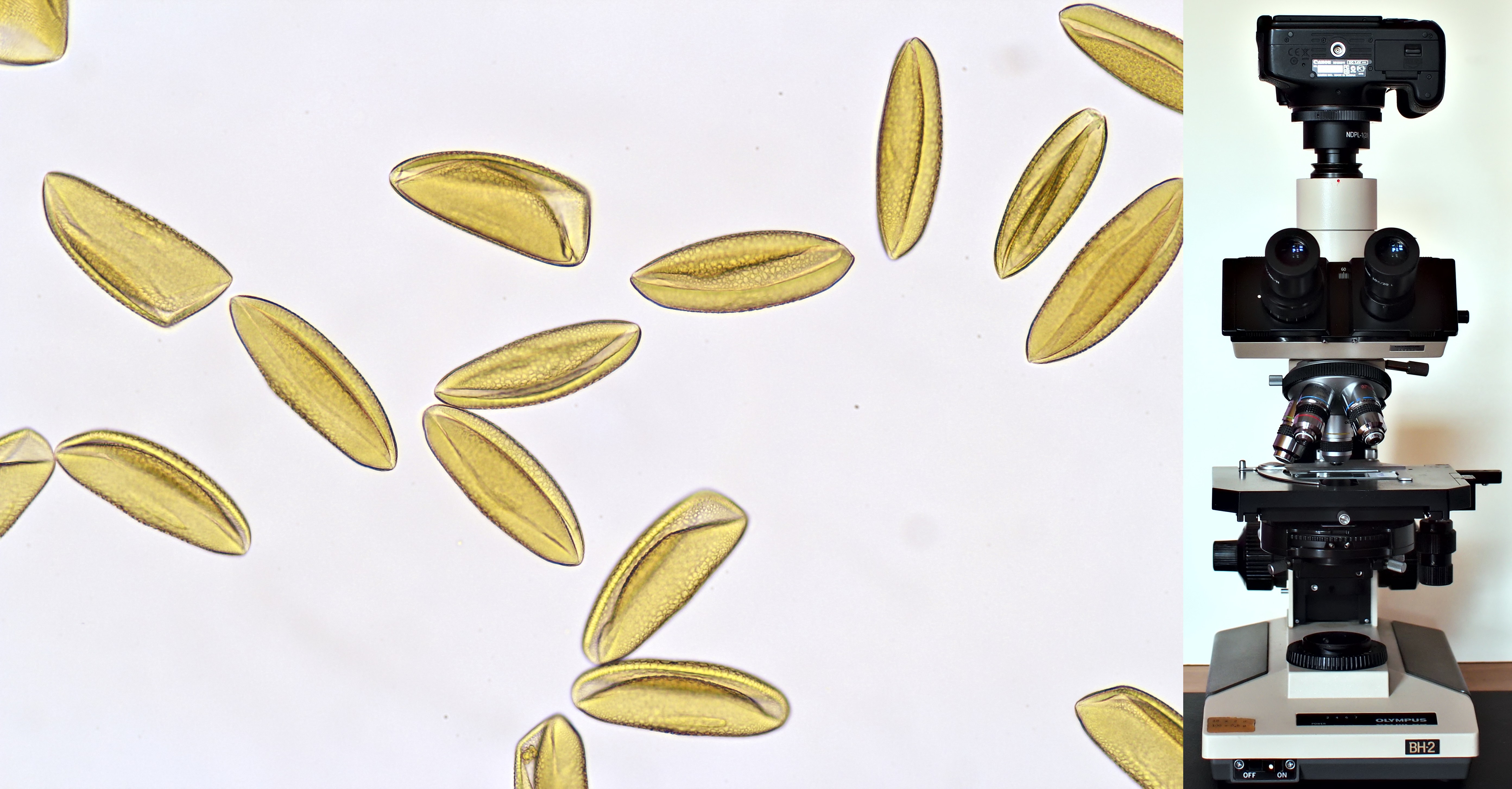
Amaryllis pollen photographed with an Olympus S-Plan 20/0.46 objective. Here, the field lens of a Leitz Periplan GF10x was used. Right: Olympus BH2 microscope with a Canon 600D camera connected to the photographic tube via an NDPL-1 adapter.
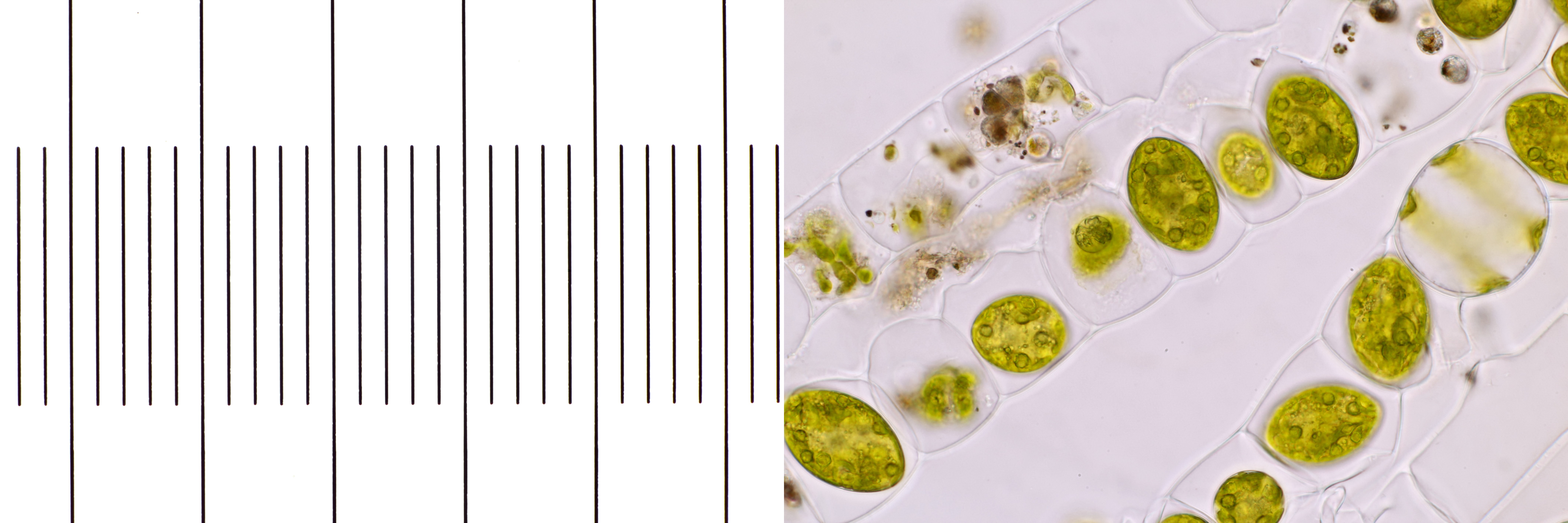
Stage micrometer (left) and Spirogyra with zygotes (right) photographed with Olympus S-Plan 40/0.70 objective and the Olympus BH2 microscope. The field lens of a Leitz Periplan GF10x eyepiece was used here. Camera: Canon 600D.
Conclusion
Inserting a field lens from an eyepiece into a universal DSLR adapter corrects the chromatic aberration that normally occurs with this type of adapter. Additionally, a significantly larger portion of the field of view is photographed than when the adapter is used without a field lens. With this simple modification, these adapters become more suitable for photography with microscopes with finite optics.