
 NL
NL
 EN
EN
 DE
DE
While shopping at a very popular store in the Netherlands, I came across a LED light that proves to be very useful for microscopy. This is the so-called 'Baltimore LED light set - white LED'. It is a set of 3 lights that are rechargeable via USB-C. It also includes a remote control with which the color temperature and intensity can be adjusted. Two LEDs are mounted side by side in the lamp; one LED emits a cool white light and the other a yellowish light. Three settings are possible: cool white, warm white, and warm. In the warm white setting, both LEDs are switched on. The light intensity is adjustable from 10% to 100%, where 100% is very bright (do not look directly into the lamp!). When used for microscopy, it is recommended to use a diffusing filter and place them in the filter holder (if present). The frosted filters are necessary to scatter the light from the point light source so that uniform illumination and sufficient resolution are achieved. They also temper the very bright light; without frosted filters, it can be harmful to the eyes.
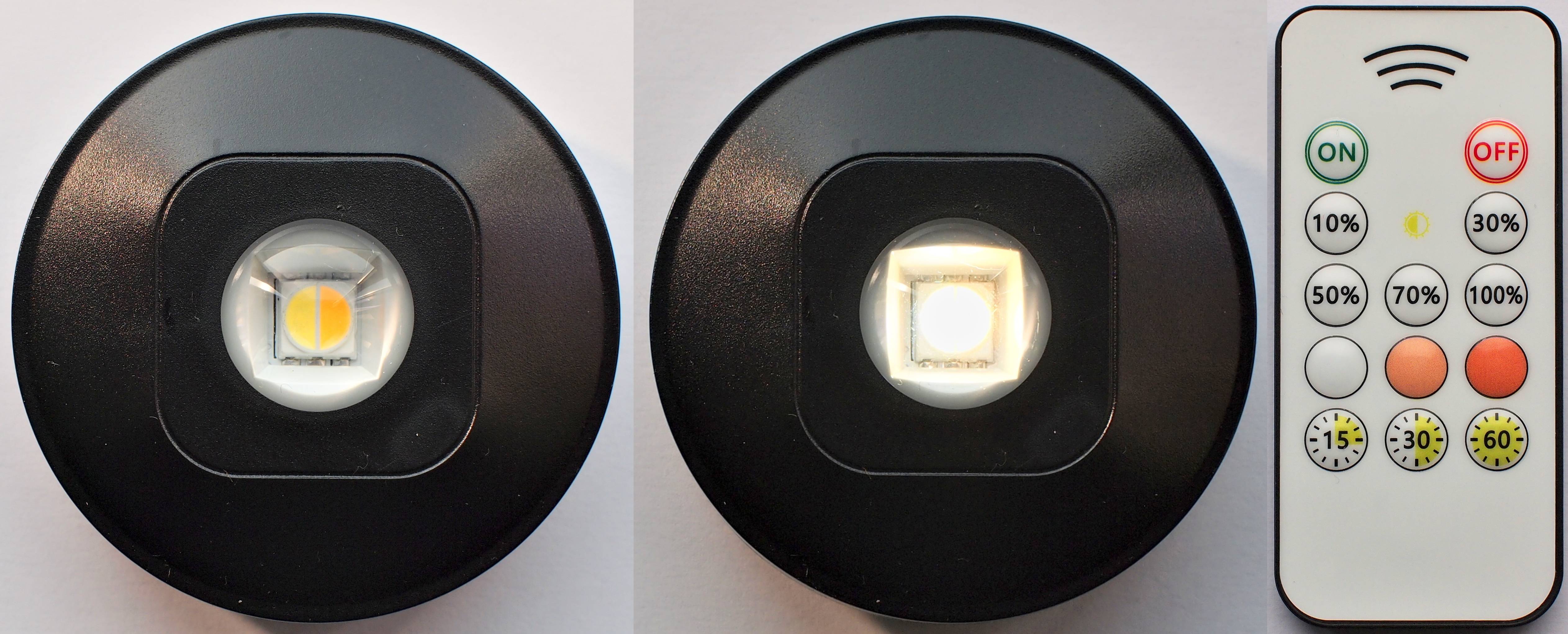
Left: LED lamp showing the 2 side-by-side mounted LEDs. Middle: LED in the middle setting (warm white) with both LEDs on. Right: Remote control for adjusting color temperature and intensity.
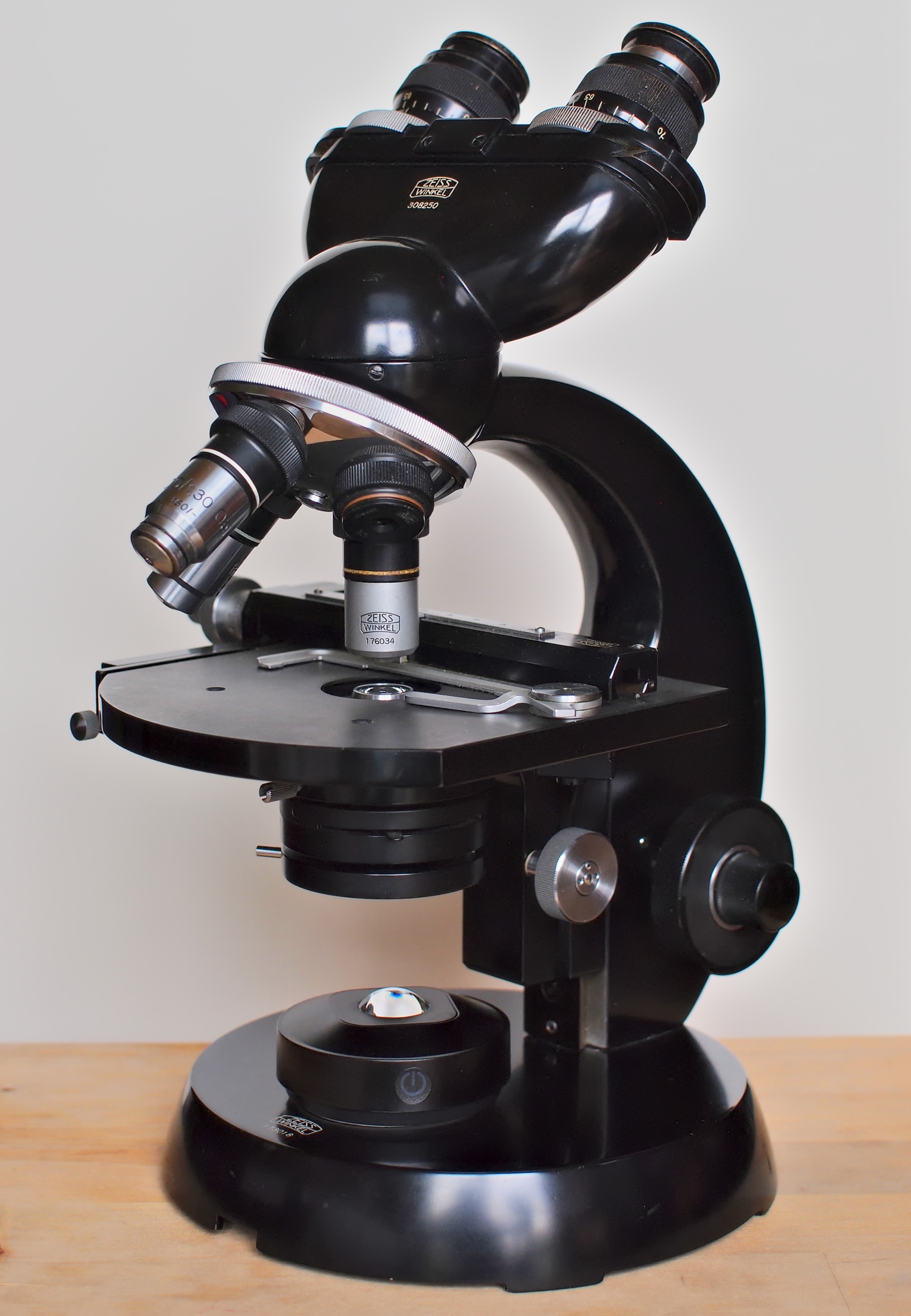
LED lamp placed on the base of the Zeiss-Winkel Standard Junior. Aesthetically, it is perfect.
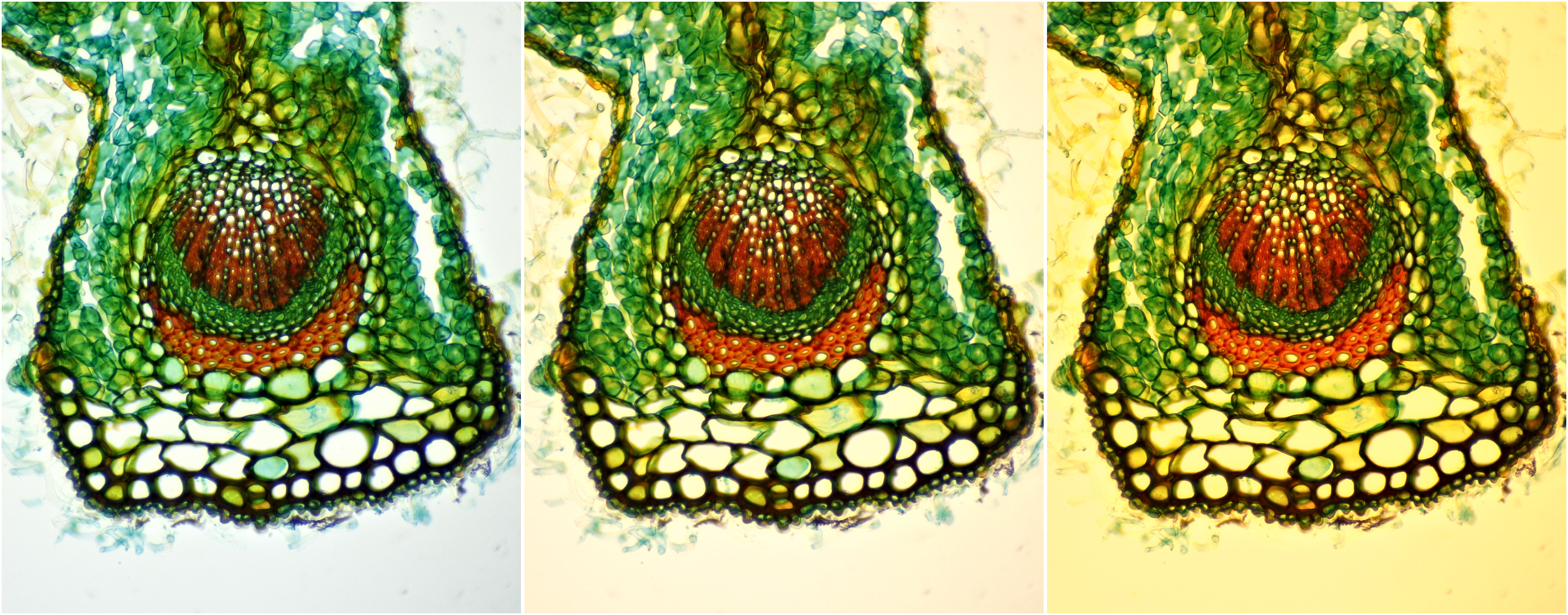
Leaf cross-section of Rosmarinus officinalis photographed with Zeiss-Winkel 10/0.25 and the 3 different color settings. From left to right: cool white, warm white, and warm.
Personally, I find the middle setting (warm white) the most pleasant. Particularly at lower magnifications, a slight color gradient may appear in the field of view; this is because the two LEDs next to each other have different colors. In that case, the condenser height needs to be adjusted slightly (lower position), or an additional diffusing filter can be used for better light scattering. The light intensity is more than sufficient for the various illumination methods. I found that there was still enough light when using phase contrast with a 100/1.25 lens.

The LED lamp fits perfectly into the opening on the base of the Olympus-E microscope. This setup works much better than when the original Köhler lamp is mounted, which often gets in the way.

Slide of a monocotyledonous root photographed in brightfield (left) and polarized light (right). The images were taken with the Olympus E microscope and the Baltimore LED lamp. Objective: Olympus Plan 10/0.25.
There is another way to diffuse the light from the lamp: applying tape to the lamp itself. I used a piece of painter's tape for this, which ensures that the light is strongly scattered. This way, there is no need to place a frosted filter in the filter holder. Despite the tape, the light intensity remains very strong at the maximum setting.
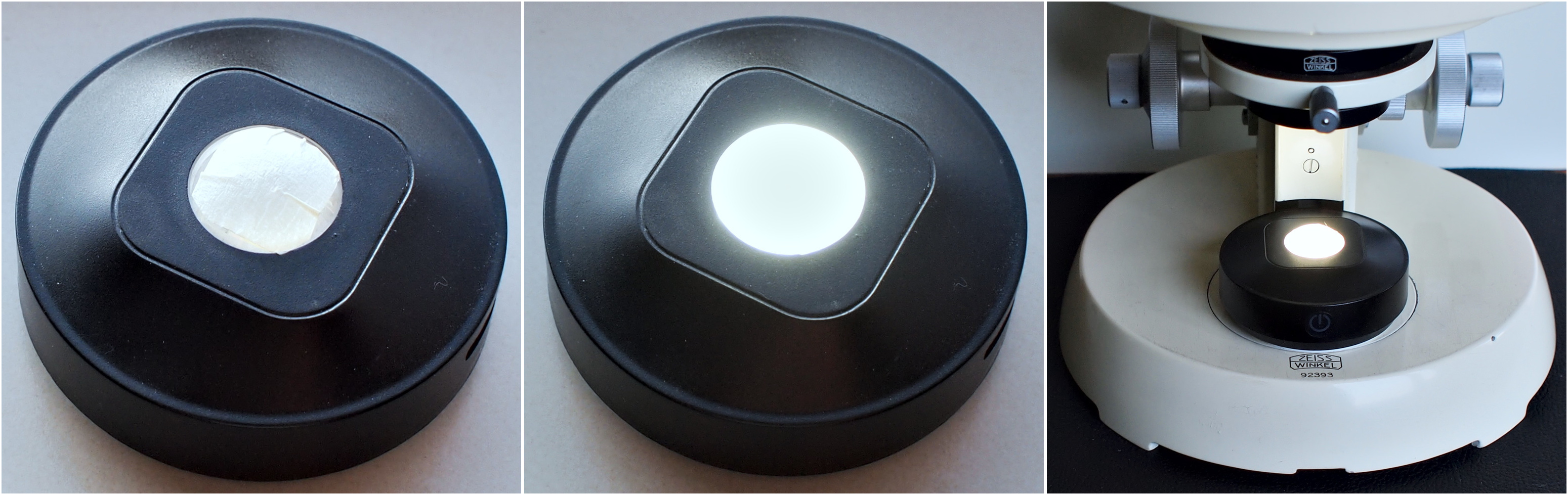
A piece of painter's tape is applied to the Baltimore LED lamp (left), resulting in a beautiful diffusion of light (center). Right: the LED lamp on the base of a white Zeiss-Winkel Standard GF.
Conclusion
For less than ten euros, LED lighting is available that can be used perfectly for microscopes.