 NL
NL
 EN
EN
 DE
DE
I offer courses for people who are interested in getting started with microscopy. The course will be adjusted according to the interests of the participants. So, if you want to work with a microscope purely as a hobby, for something specific or for professional purposes, you can contact me.

Microscopy course
If you look through a microscope you will discover that a separate world exists that is usually hidden from us. Unlike binoculars, which are used to observe known things, you will enter an unknown world with a microscope. This world is a universe in itself. You will be amazed by the fantastic micro structures of plants and the bizarre shapes of single-celled organisms. Up close, leaves look like mosaic artworks and some single-celled creatures would do very well in a science-fiction film. Science and art are brought together with a microscope, it is actually quite strange that not many artists seem to have been inspired by the microscopic world. What's more, you will learn a lot about how nature works when you look through a microscope. Many people think that microscopy is too complicated or that a very expensive microscope is required. Nothing is less true. A lot can be seen with a simple school- or student microscope.
During the summer season I often stay at a garden park called Nieuw Vredelust in Duivendrecht. Here, I examine all kinds of things with a microscope. A garden park is a fantastic location for a microscopic adventure. There is so much to see and explore: during the summer the ditches are teeming with all kinds of microscopic life, colorful flowers and leaves are beautiful up close and you will be surprised by the look of small seeds when magnified.
Microscopy can also be very useful within the house. For example, if you're not sure if some food has been expired you would be able inspect it with a microscope and look for the presence of bacteria or fungi.
I would like to introduce people to the microscopic world. During the workshop you can look through different microscopes and examine things that you find interesting. After an introduction I will explain how to view the different samples with a microscope. This can be anything: plant cells, water from a ditch, pollen, hairs, sand, insects, small seeds, etc., etc. I will also explain what you are all seeing. Furthermore I will demonstrate how to take pictures through a microscope; with a smartphone you can already take very nice photos. There are several microscopes available and if you want to bring something with you to examine it yourself or to have it examined, you are very welcome.
A workshop lasts 4 hours (with possible extension) and covers everything related to microscopy, specifically tailored to your area of interest. I usually teach workshops individually, for one to two people, or in small groups of up to four. In this small-scale setting, the information is better conveyed and there's more individual attention than in a large group.
Locations / contact
• Amsterdam
• Duivendrecht, allotment garden park Nieuw-Vredelust: https://www.tuinparknieuwvredelust.nl/
• Zevenaar
Email: rolf(at)microscopievandenatuur.nl
Subjects workshop microscopy
If you have become interested or want to learn more about certain subjects, you can contact me for an extensive workshop. Below is a list of topics that could be covered.
You can bring your own samples and materials for examination.
Introduction
• Microscopy as a hobby or tool, for inspiration or professional purposes.
• The microscope: introduction, history, applications.
• Using the microscope, discussion of various parts.
• Types of microscopes.
• Clearing up misconceptions: the facts and myths.
If you already have a microscope or would like to purchase one
• I inspect the microscope to see if everything is working properly.
• I'll check the optics and clean all the lenses if necessary.
• Objectives and eyepieces are often dirty and cleaning them requires a specific method.
• If you are considering purchasing a microscope, I will provide comprehensive advice.
Working with a microscope
• From smallest to largest magnification.
• Which magnification for which object?
• Dealing with exposure and aperture. Exposing the specimen correctly.
• Illumination is crucial and makes the difference between a good and bad image.
• Focussing: coarse and fine adjustment.
• Learn how to look with one eye while the other is kept open (monocular microscope).
• Working with a binocular microscope.
Illumination techniques
• Brightfield illumination.
• Oblique illumination.
• Darkfield illumination.
• Phase contrast.
• Using incident light.
• Observing specimens in polarised light.
Explanation of cells, cell structures, and microorganisms
• Plant cells: e.g., chloroplasts, crystals, stomata.
• Unicellular organisms such as amoebae, ciliates, and flagellates.
• Algae, fungi, and bacteria.
Examine plant cells and tissues
• Wet mount slides from fruits and vegetables like rose hip, potato, banana, tomato, paprika.
• Examine petal cells of, for example, violets and marigolds.
• Examine intact leaves of Rosa, Fagus, Corylus, Tradescantia.
• Making wet mount slides of e.g. Tradescantia zebrina, onion, hosta, cherry laurel.
Water and aquatic plants from ditch, river and pond
• View different types of algae.
• Protozoa, diatoms, water fleas, rotifers.
• Observe cytoplasmic streaming in Elodea.
Pollen
• Alcea rosea, sunflower, pine, tulip, lily.
• Pollen in honey.
Sand
• Examining different types of sand.
• Illumination techniques.
Bacteria
• In buttermilk, yogurt, saliva.
Cheek epithelial cells
• View your own body cells!
Mosses
• Structure of miniature leaves.
3D viewing with a stereo microscope
• Watching insects, compound eyes and wings are true works of art.
• The scales of a butterfly wing look like colorful roof tiles.
• Tiny seeds and flowers look fantastic enlarged in 3-D.
• Look at everyday materials such as salt and sugar.
Hairs, fibers, dust
• View fibers and dust with polarized light.
Parasites in animals
• Advice on which microscope you need.
• Useful magnifications, and illumination techniques.
• I do not work with material that is potentially infectious to humans.
Record your observations
• Drawing.
• Photography.
• Video.
Photography through the microscope
• The possibilities and pitfalls.
• Taking photos through the microscope with a smartphone, compact camera or system camera.
• You can bring your own camera to see what's possible.
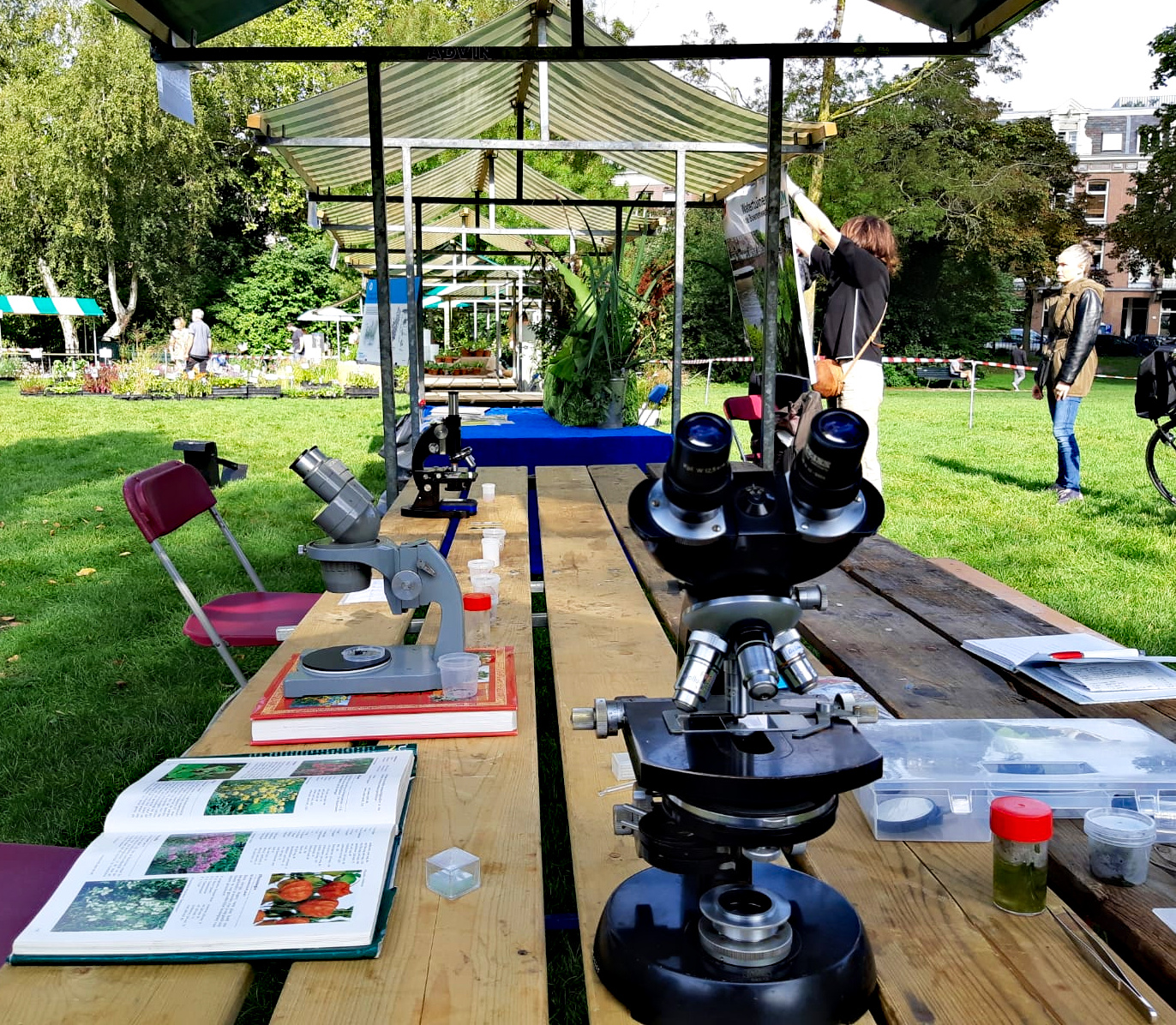
I sometimes do demonstrations on location, like shown here at the Sarphatipark in Amsterdam at the 'Herfstmarkt' of 2020. It was a beautiful sunny September day.